Call Us -
Cart
0
A wet bathroom floor can turn a normal morning routine into a serious fall risk in seconds. That is why the best bathroom safety products are not just convenience items. For many seniors, caregivers, and healthcare providers, they are a practical part of safer daily care at home, in assisted settings, and in clinical environments.
Bathrooms create a unique mix of hazards. Hard surfaces, tight spaces, standing transfers, and water all increase the chance of slipping or losing balance. The right product setup can reduce those risks, but the best choice depends on the user’s mobility, strength, bathroom layout, and level of support available. A product that works well for one household may not be enough for another.
What makes the best bathroom safety products worth buying
The most useful bathroom safety products do two things well. They reduce risk during common movements such as sitting, standing, stepping over a tub wall, or getting in and out of the shower. They also make those movements feel more manageable, which matters just as much for confidence as it does for safety.
Good products should be stable, easy to clean, and realistic for the space available. A large transfer bench may offer excellent support, but it can be a poor fit in a small bathroom. A suction grab bar may seem convenient, but it is not a substitute for a properly installed permanent grab bar when weight-bearing support is needed. In other words, safety starts with matching the product to the task.
Best bathroom safety products for everyday fall prevention
Grab bars
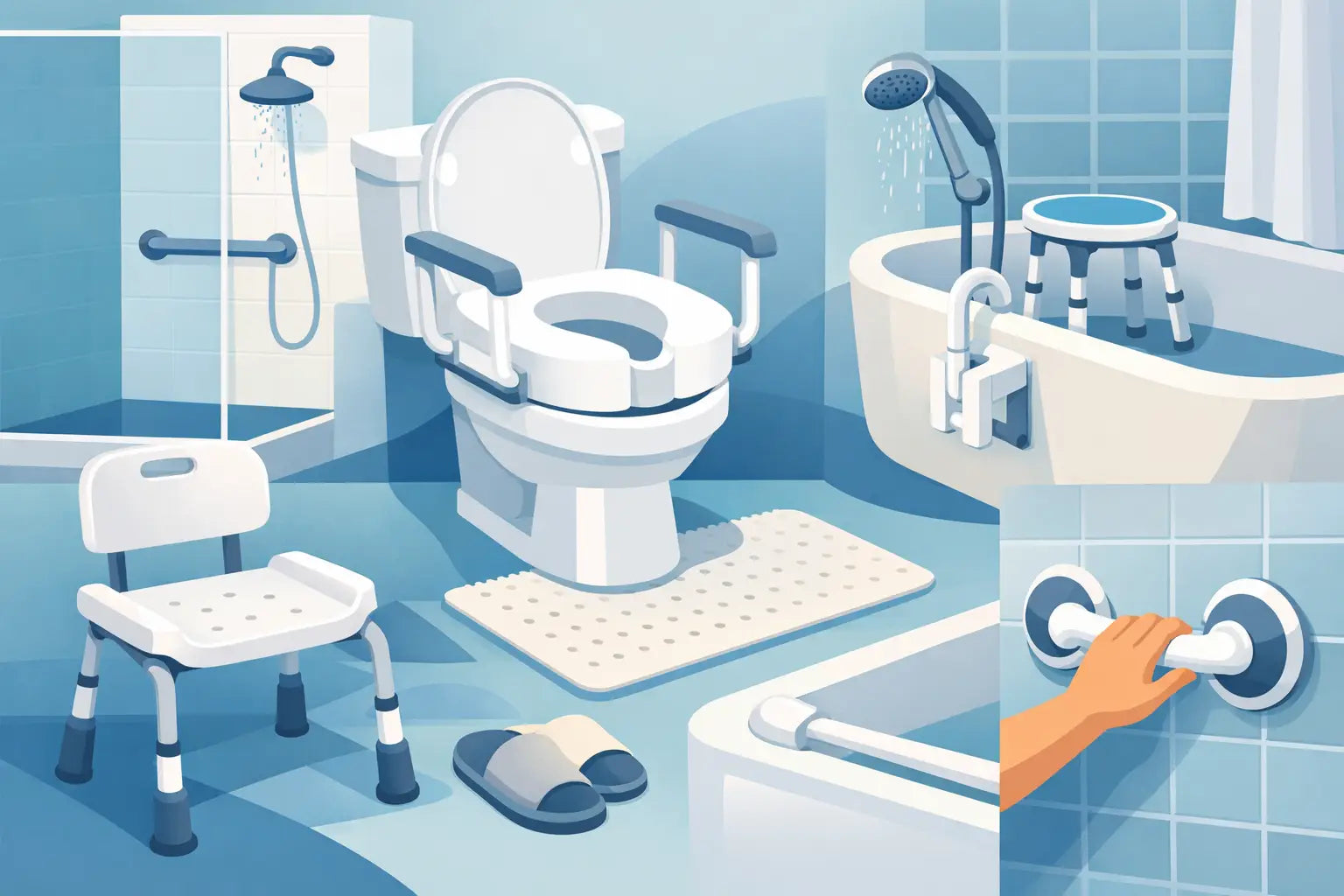
Grab bars are often the first product people think of, and for good reason. They provide support during some of the most difficult bathroom movements, especially lowering onto the toilet, standing back up, and stepping into a tub or shower.
The best option is usually a permanently mounted grab bar installed into wall studs or with appropriate secure mounting hardware. These bars are designed for true weight support. Placement matters. A bar beside the toilet helps with seated transfers, while bars at the shower entrance and along the shower wall can support stepping and standing.
Suction-style bars may have a place as a light balance aid for some users, but they are not dependable for full body weight. For anyone with significant mobility issues, weakness, or a history of falls, mounted bars are the safer choice.
Non-slip bath mats and adhesive strips
One of the simplest upgrades is also one of the most effective. Non-slip surfaces inside the tub or shower help reduce slips where water and soap build up quickly.
Bath mats with strong grip and low-profile edges work well in many homes. Adhesive anti-slip strips can also be a good option when a full mat is harder to keep clean. The trade-off is maintenance. Mats need regular cleaning and replacement over time, while strips may peel if they are not applied properly or if the surface is worn.
Raised toilet seats
A standard toilet can be too low for users with limited knee bend, reduced leg strength, recent surgery, or balance problems. Raised toilet seats shorten the distance needed to sit and stand, which can reduce strain and lower fall risk.
Some models attach directly to the toilet for a more secure fit. Others include armrests for extra leverage. The right height matters. Too low, and it does not solve the problem. Too high, and it can make seated positioning awkward. For post-surgical recovery or long-term mobility support, this is often one of the best bathroom safety products because it improves a daily task without requiring a full bathroom remodel.
Toilet safety frames
A toilet safety frame adds side support around the toilet and can be especially helpful for users who need arm support on both sides. Unlike a wall-mounted bar, it does not require installation into the wall, which makes it useful in rental properties or temporary recovery setups.
This can be a strong option after hip or knee procedures, or for individuals with general weakness. Still, frame stability varies by model, so weight capacity and fit should be checked carefully.
Best bathroom safety products for safer bathing
Shower chairs and bath benches
For anyone who tires easily, has poor balance, or cannot stand comfortably for a full shower, a shower chair can make bathing much safer. It reduces the need to stand on a wet surface and gives the user more control during washing.
Chairs work well in walk-in showers, while wider bath benches can help in larger shower spaces. Look for non-slip feet, drainage, and height adjustability. Padded seats may feel more comfortable, but they can require more upkeep than hard plastic designs.
Transfer benches
A transfer bench is often the better choice when a tub wall is hard to step over. One side of the bench stays outside the tub, the user sits down first, and then slides across into the bathing area. This reduces the need to lift the legs over the edge while standing.
For many caregivers, this is one of the best bathroom safety products for reducing assisted transfer strain as well. It is not the most compact solution, and it takes more space than a standard shower chair, but for tub access it can be a major safety improvement.
Handheld shower heads
A handheld shower head is a small upgrade with real practical value. It allows seated bathing, easier rinsing, and less twisting or reaching. That matters for people with limited shoulder mobility, weakness, or poor endurance.
It is most effective when paired with a shower chair or transfer bench. On its own, it does not prevent falls, but it does make safe bathing setups more functional.
Best bathroom safety products for support during transfers
Bedside commodes for limited mobility
In some care situations, the safest bathroom product is not in the bathroom at all. A bedside commode can reduce urgent nighttime trips to the bathroom for patients with severe weakness, high fall risk, or recent surgery.
Many models can also be used over an existing toilet to add height and arm support. This makes them useful for both temporary and ongoing care. For households managing recovery at home, the flexibility can be a major advantage.
Floor-to-ceiling poles and transfer aids
Vertical support poles can help users steady themselves during standing and turning, especially in bathrooms where wall placement limits grab bar installation. Some tension-mounted poles are designed for residential use and can offer a useful handhold near toilets or bathing areas.
These products are not right for every room or every user. They need proper setup, and they should never be treated as interchangeable with fully mounted structural support when high weight-bearing assistance is needed.
Features to look for before you buy
The best bathroom safety products should fit both the person and the space. Weight capacity is one of the first things to confirm, especially for bariatric use or frequent assisted care. Product dimensions matter just as much. A bench that is technically effective but too wide for the tub or too deep for the bathroom can create new obstacles instead of solving old ones.
Ease of cleaning should not be overlooked. In home care and clinical settings, surfaces that resist moisture buildup and clean quickly help support hygiene and long-term use. Adjustable height is another valuable feature because a better fit usually means better stability and comfort.
If the product is meant to support body weight, secure installation or dependable frame design should be non-negotiable. This is where cutting corners can become dangerous.
Choosing the right setup for the user
Not every bathroom needs every product. A relatively independent older adult may only need grab bars and non-slip protection. A person recovering from surgery may benefit more from a raised toilet seat, handheld shower head, and shower chair. Someone with more advanced mobility limits may need a transfer bench, toilet frame, and bedside commode as part of a broader home safety plan.
Caregivers and clinicians should think in terms of movement. Where does the user struggle most - sitting down, standing up, stepping over the tub, or remaining stable during bathing? Once that is clear, product selection becomes more straightforward.
For buyers who want dependable home and clinical support items in one place, US MedResources serves both individual households and care providers with practical equipment designed for real-world use. That kind of direct access can save time when safety needs are immediate.
When simple products are not enough
Bathroom safety products can reduce risk, but they do not replace clinical judgment or home assessment when a user’s condition is changing. If falls are becoming more frequent, if transfers require hands-on support, or if confusion and poor judgment are part of the picture, a more complete care plan may be needed.
Sometimes the right answer is not another accessory. It may be supervision, physical therapy input, or a change in the bathing environment itself. Products work best when they are part of a setup that matches the person’s current ability, not the ability they had six months ago.
The safest bathroom is the one that supports everyday routines without forcing risky movements. Start with the problem that happens most often, choose products built for that exact job, and make the room easier to use before it becomes urgent.