Call Us -
Cart
0
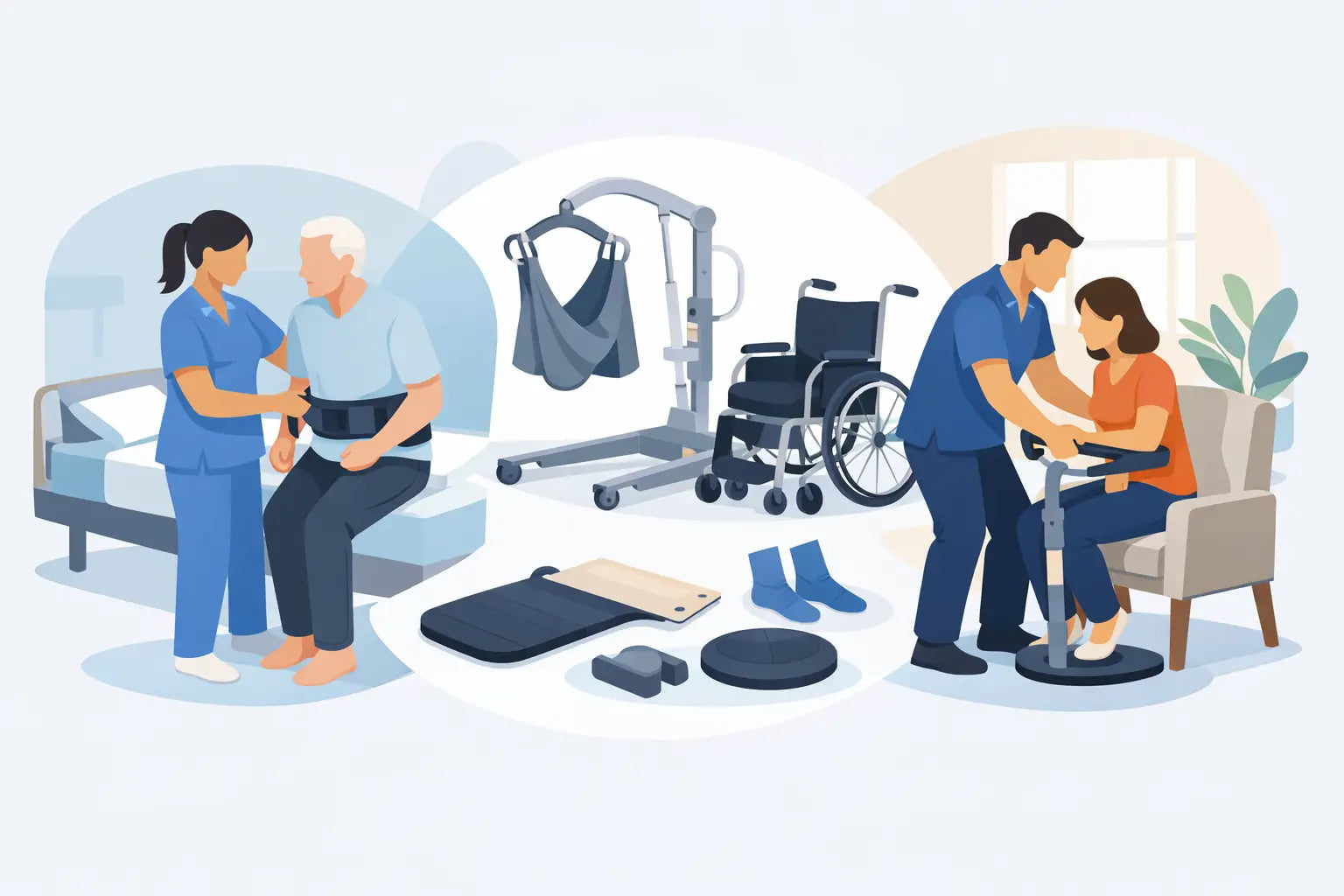
A transfer gone wrong usually happens in a few fast seconds - a weak knee, a bad grip, a caregiver twisting the wrong way. That is why patient transfer aids matter so much in daily care. The right equipment can lower fall risk, reduce strain on caregivers, and make movement from bed to chair, toilet, wheelchair, or exam table more controlled and less stressful for everyone involved.
For home caregivers, transfer equipment often becomes necessary sooner than expected. A person may walk short distances but still need help standing. A post-surgical patient may be steady in the morning and exhausted by afternoon. In clinical settings, staff may handle many transfers in a single shift, which raises the risk of back, shoulder, and wrist injuries when the wrong method is used. Good transfer support is not only about comfort. It is about safety, consistency, and protecting both the patient and the person providing care.
What patient transfer aids are designed to do
Patient transfer aids are products that assist with moving a person from one surface or position to another with more control. That might mean helping someone stand, pivot, slide, reposition, or lift. Some are simple and low-tech, while others are designed for full-body support when a patient cannot bear weight safely.
The best choice depends on three things: the patient’s mobility, the care setting, and how often transfers happen. A person recovering at home after joint surgery may only need a gait belt and a transfer board for a short period. Someone with progressive weakness or limited trunk control may need a mechanical lift for longer-term care. Clinics and facilities often need options for different patient sizes, levels of assistance, and room layouts.
Common types of patient transfer aids
Not every transfer calls for the same equipment. Matching the tool to the task is what makes care safer and more efficient.
Gait belts and transfer belts
A gait belt is one of the simplest transfer tools, but it still needs to be used correctly. It gives the caregiver a more secure handhold during assisted standing or pivot transfers. This can be useful for patients who can bear some weight and follow directions.
A gait belt is not a lifting device. If the patient cannot stand reliably, starts to collapse, or has poor balance with little trunk control, the belt alone may not provide enough support. In those cases, trying to force a transfer with a belt can increase risk instead of reducing it.
Transfer boards
Transfer boards, sometimes called slide boards, help bridge the gap between two surfaces such as a wheelchair and a bed. They are often used for patients with limited lower-body function who still have enough upper-body strength and awareness to assist with movement.
These boards can work well in both home and rehab settings, but they require setup, proper positioning, and enough space. Clothing friction, uneven surface heights, and poor arm strength can make a board transfer harder than it looks.
Sit-to-stand aids
Sit-to-stand devices are useful for patients who have some leg strength but need support rising from a seated position. They can help with transfers from bed to chair, chair to toilet, or similar short movements.
This category can be a strong middle ground between manual assistance and full lifts. It supports safer movement while encouraging some participation from the patient. Still, it is only appropriate when the patient can tolerate standing and has enough strength and stability to cooperate with the motion.
Mechanical lifts
Mechanical lifts are often the safest option for patients who cannot bear weight, need full assistance, or have complex mobility limitations. These lifts use slings and lifting frames to move the patient with less physical strain on staff or family caregivers.
For many homes, the main questions are space, storage, and ease of use. For facilities and clinics, sling compatibility, cleaning protocols, and daily workflow matter just as much. A mechanical lift can be a major improvement in safety, but only if caregivers are trained to use it properly and consistently.
Repositioning sheets and slide sheets
Not every transfer is from one chair to another. Sometimes the challenge is moving a patient up in bed, turning them, or reducing friction during repositioning. Slide sheets and repositioning aids can make these tasks easier while lowering the risk of skin injury and caregiver strain.
This is especially important for patients with limited mobility, fragile skin, or a higher risk of pressure injuries. Small improvements in repositioning can have a big effect over time.
How to choose the right transfer aid
The first question is not what product looks easiest to buy. It is what the patient can safely do. Can they bear weight? Can they follow simple instructions? Do they fatigue quickly? Are there recent surgeries, fractures, or balance problems that change the transfer plan?
Next, think about the environment. Home bathrooms are often tight. Bedrooms may not have enough clearance for a larger lift. Wheelchairs, recliners, and low beds can all affect transfer angles. A tool that works well in a hospital room may be awkward in a small apartment.
Frequency also matters. If a caregiver is helping with one transfer a day, the equipment needs may be different than in a clinic where staff perform repeated transfers throughout the shift. Repetition increases injury risk, so efficiency becomes part of safety.
It also helps to consider who will use the equipment. A trained rehab professional may be comfortable with techniques that would be unrealistic for a family member with no medical background. In home care, simpler equipment that can be used correctly every time is usually better than a more advanced option that feels intimidating.
Safety points that should never be skipped
Even the best transfer equipment has limits. A transfer aid is not a substitute for judgment. If the patient seems weaker than usual, dizzy, confused, or in pain, the plan may need to change.
Before any transfer, check that wheels are locked when appropriate, surfaces are stable, and the path is clear. Footwear matters more than many people expect. Loose socks and slippery floors can turn a routine transfer into a fall. Sling fit, belt placement, and body positioning should also be checked every time, not just during training.
Caregiver body mechanics are just as important. Reaching, twisting, and trying to catch a falling patient are common causes of injury. The goal is controlled movement, not speed. If a transfer regularly feels too hard, that is usually a sign the current method is not the right one.
Patient transfer aids in home care vs. professional settings
At home, the priority is often ease of use. Caregivers want products that are straightforward, compact, and dependable. They may also need help understanding which option fits a specific diagnosis or recovery stage. Clear product selection matters because most home users are not ordering from a clinical purchasing department.
In professional settings, the focus often expands to durability, repeated use, patient volume, and staff protection. A clinic may need transfer solutions that work across a range of body types and functional levels. Long-term care and rehab environments may need several categories of transfer support, not just one.
That is where a broad medical supply source becomes useful. US MedResources serves both home-based customers and professional buyers who need practical equipment options delivered directly and backed by straightforward ordering support.
When it may be time to upgrade your transfer setup
If transfers are becoming slower, less stable, or more physically demanding, it may be time to reassess. Care needs change. A product that worked after discharge may no longer be enough a few months later. New weakness, fear of falling, weight changes, or caregiver fatigue can all be signs that the current setup is no longer the safest option.
Waiting too long often leads to near-misses first and injuries later. A better transfer aid can protect the patient’s dignity while also reducing the day-to-day stress on caregivers and staff. That is a practical improvement, not a luxury.
The right transfer support should make daily care feel more manageable. If a move from bed to chair has become something everyone dreads, that is worth addressing now. Safer transfers protect independence where possible, protect caregivers where needed, and make the whole care routine more workable one step at a time.